Why More Young Adults Are Joining the Church This Easter — and Why That Still Doesn’t Automatically Mean Revival
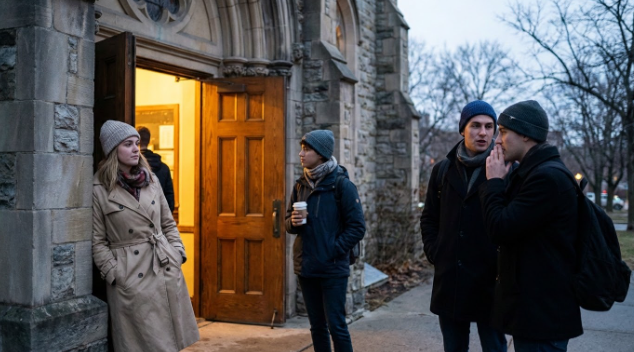
The recent rise in adult baptisms and initiations matters. But the real story is not hype. It is hunger.
For years, the dominant story about Christianity in the West has been decline.
Shrinking attendance. Institutional distrust. Younger generations drifting from church, or leaving it altogether. That narrative has been repeated so often that many Christians now treat it like weather: unfortunate, but inevitable.
And then a strange thing happened this Easter.
Religion News Service reported on April 3 that Catholic parishes in the United States were preparing to welcome unusually large numbers of new members, with many of them young adults. The coverage pointed to several drivers behind the increase, including Catholic influencers, sacramental curiosity, and a broader search for meaning and structure among younger people. (RNS)
On its face, that sounds like revival. It certainly sounds like a reversal.
But just a few days later, RNS published a follow-up warning against reading too much into the numbers too quickly. Yes, adult baptisms and initiations are up. Yes, young adults are showing unusual interest. But no, that does not necessarily mean the United States is suddenly in the middle of a sweeping Catholic revival. The deeper trend line remains complicated, and the number of people entering churches still exists inside a larger culture where many others continue leaving them. (RNS)
That tension is where the real story lives.
This is not mainly a statistics story. It is a meaning story.
What makes this moment interesting is not just that some churches are reporting fuller Easter vigils. It is why younger adults seem open again.
The best reporting on this trend points to a familiar ache: people want something thicker than the digital world can give them. They want ritual, meaning, seriousness, belonging, transcendence. They want a faith that feels embodied, not merely inspirational. In the RNS reporting, younger adults were drawn not only to ideas, but to practices — sacraments, liturgy, and the sense that Christianity offers more than spiritual vibes and self-improvement language. (RNS)
That matters because modern Christianity has a tendency to misread moments like this.
One side sees a story like this and rushes to triumph: See? The young are coming back. We were right all along.
The other side sees it and shrugs: Anecdotes. Doesn’t change the secularization trend.
Both responses miss something important.
The real signal here is not that all young adults are flooding back into church. It is that the old assumption — that younger people are simply done with Christianity — is too shallow. Some are leaving. Some are drifting. But some are also looking again, sometimes very seriously, for a form of faith that feels weighty enough to live inside.
In a thin culture, thick faith starts to look attractive
This is where the conversation gets bigger than Catholicism.
You do not have to be Catholic to understand what is happening here. The larger pattern is easy to recognize: in a culture of constant scrolling, endless commentary, and flattened identity, thicker forms of belief begin to feel strangely compelling.
A lot of modern life is frictionless. That sounds nice until you realize frictionless often also means rootless.
Streaming is frictionless. Dating apps are frictionless. Shopping is frictionless. Even much of online spirituality is frictionless — clips, quotes, short encouragement loops, and personal inspiration with almost no demand attached.
Christianity, at its strongest, is not frictionless.
It asks things of you. It gives shape to time. It tells you to belong, not merely consume. It confronts you with limits, mystery, repentance, embodiment, forgiveness, and commitment. For some younger adults, especially those exhausted by irony and digital performance, that kind of seriousness can feel less oppressive than clarifying. (RNS)
This is why the recent wave of attention around “Catholicmaxxing” is only part of the story, and not the deepest part. The Guardian reported on April 7 that Gen Z online culture is experimenting with a performative, image-conscious form of religion packaged through TikTok aesthetics, fasting clips, and masculine “theo bro” branding. But even that trend, however shallow parts of it may be, reveals the same basic fact: religion is re-entering the imagination of some younger people as something more than private background noise. (The Guardian)
The challenge, of course, is that image and substance are not the same thing.
Christianity cannot survive as a vibe alone
This is where churches should be careful.
Whenever interest rises, institutions get tempted to confuse curiosity with commitment. Attention is not discipleship. Aesthetic attraction is not endurance. Someone showing up for Easter, or even entering RCIA, is not yet proof that the deeper cultural tide has turned.
And yet it would also be foolish to dismiss these signals because they are messy.
Every real movement starts messy.
The better question is not: Are we in revival?
The better question is: What kind of spiritual hunger is actually showing up here?
If younger adults are indeed moving toward church spaces in search of meaning, order, reverence, and reality, then modern Christianity needs to meet that hunger with more than marketing. It needs to offer something durable. Something inhabitable. Something that does not collapse the moment the mood changes.
That may mean clearer teaching. It may mean more beautiful liturgy. It may mean stronger communities. It may mean recovering the idea that Christianity is not mainly content to consume but a life to enter.
Because if people are coming back, even tentatively, they are not just looking for better branding.
They are looking for a faith substantial enough to hold the weight of actual life.
What this means for modern Christianity right now
This story matters because it exposes both a promise and a risk.
The promise is that younger adults are not spiritually numb in the way many assumed. Beneath the cynicism, beneath the irony, beneath the post-institutional fatigue, there is still longing.
The risk is that churches misdiagnose what is happening and respond with either shallow celebration or shallow suspicion.
Modern Christianity needs more maturity than that.
It needs to understand that younger adults are often not asking, “Can you entertain me?” They are asking, even if indirectly, “Can you give me something real enough to build a life on?”
That is a very different question.
And it may be one of the most important questions the church will face over the next decade.
3 takeaways
1. The rise in Easter initiations is real, but it is not a simple revival headline.
The numbers matter, but they sit inside a more complicated spiritual landscape. (RNS)
2. Younger adults are not just looking for spiritual content. They are looking for structure, seriousness, and belonging.
That is why sacramental and liturgical traditions are drawing fresh attention. (RNS)
3. Modern Christianity should resist both hype and cynicism.
This moment is better understood as a sign of hunger than a proof of victory.
More young adults joining churches this Easter does not automatically mean the culture has turned around. But it does mean the old assumption — that younger generations are simply finished with Christianity — is too simple. Something deeper is stirring, and wise churches will treat it with seriousness, patience, and substance.
Need a steadier next step for real life? Get your personalized daily coaching drop at ZUL Daily Verse — a Bible verse, a modern-day translation, and 3 practical actions for today.
