When a Church Hosts Controversial Art, It Reveals What It Thinks the Gospel Is For
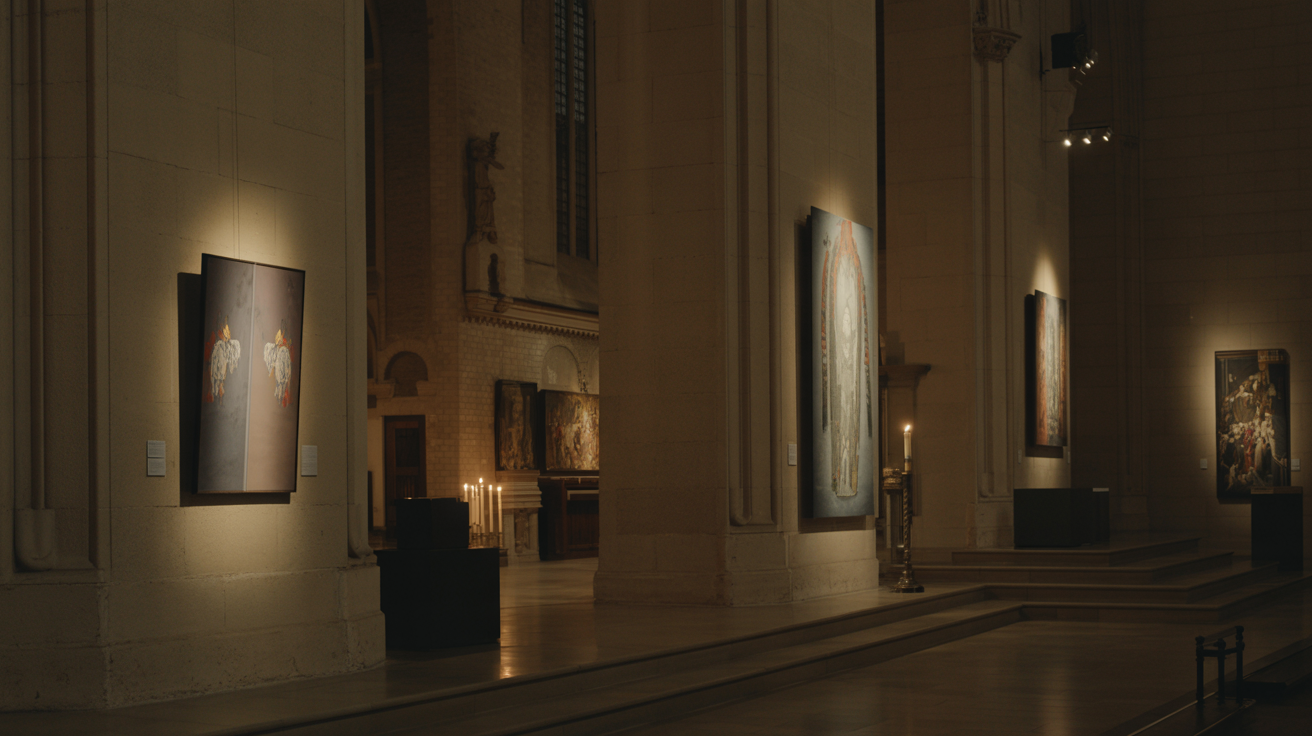
On May 4, Religion News Service reported that Jesuit artist Brian Whelan’s exhibition “Twilight of the Idols” found a new home at the Church of St. Francis Xavier after a sudden cancellation at New York’s Sheen Center. Whatever one thinks of the exhibition itself, the episode became bigger than one artist or one venue. It raised an old but still unresolved question inside modern Christianity: what is the church supposed to do with art that is spiritually serious, culturally unsettling, and not instantly reassuring? (RNS)
That question matters because churches often reveal their theology not only in what they preach, but in what they are willing to host.
A church that treats art only as decoration will usually welcome whatever feels safe, familiar, and affirming. A church that understands art as part of truth-telling will sometimes make room for work that unsettles, provokes, and asks difficult questions. The line between those two instincts says a lot about how a community understands the gospel itself.
If the gospel is mainly about preserving emotional calm and protecting public respectability, then difficult art will always feel threatening. But if the gospel is also about exposure, repentance, honesty, and the naming of idols, then art that discomforts us may at times be more faithful than art that simply flatters us. (RNS)
That does not mean every “provocative” work deserves a church wall. Discernment still matters. Some art is merely inflammatory. Some is spiritually shallow in the opposite direction. But modern Christianity often errs on the side of overprotection, especially when institutions fear controversy more than they fear dullness.
This is one reason so much explicitly Christian art can feel emotionally safe but spiritually underweight.
It decorates rather than interrogates. It comforts without revealing. It signals beauty without wrestling honestly with evil, ego, pain, or modern idolatry.
By contrast, a title like Twilight of the Idols signals a willingness to ask what false gods still shape public life — success, image, nation, certainty, even sanitized religion itself. That does not guarantee good art. But it does point toward a function that the church should not lose: helping people see what they otherwise prefer not to see.
There is also a larger cultural lesson here.
Many younger Christians are not looking for institutions that merely affirm what they already know. They are looking for communities capable of seriousness. Communities that can hold beauty and critique together. Communities that understand faith as large enough to confront the distortions of the age without collapsing into either fear or trend-chasing.
When a church hosts serious contemporary art, it quietly says: Christianity is not afraid of complexity. It can meet the modern imagination without surrendering theological depth.
That is an important witness right now.
Because modern Christianity often feels split between two bad options: aesthetic shallowness on one side and culture-war panic on the other. In that environment, churches that can host truth-telling art — wisely, carefully, prayerfully — become rare spaces of intellectual and spiritual maturity.
They tell the world that faith is not only for moral instruction or emotional uplift. It is also for seeing clearly.
And seeing clearly is one of the things human beings need most.
Sponsored


3 Takeaways
- The May 4 exhibition controversy was really about more than art. It raised the question of what churches believe truth-telling is for. (RNS)
- Modern Christianity needs better categories than “safe” or “offensive.” The more serious question is whether the work helps people see reality more truthfully.
- Churches reveal their theology through what they are willing to host. That includes their relationship to beauty, honesty, and cultural tension.
Bottom line: When a church makes room for difficult art, it is not necessarily endorsing confusion. It may be demonstrating confidence that the gospel is strong enough to confront complexity rather than hide from it. (RNS)
Need a steadier next step for real life? Get your personalized daily coaching drop at ZUL Daily Verse — a Bible verse, a modern-day translation, and 3 practical actions for today.
Try ZUL Daily Verse