
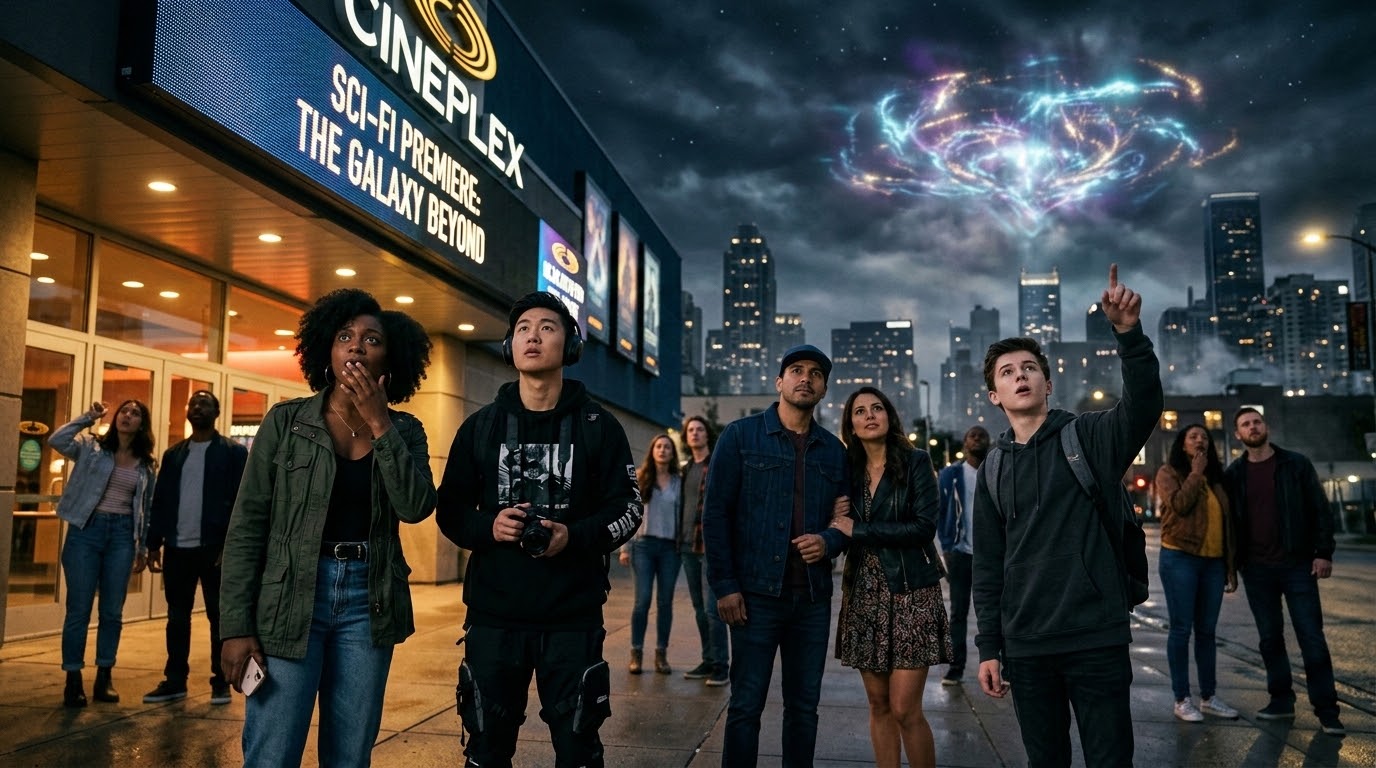
Spielberg’s “Disclosure Day” Alien Question Isn’t Really About Sci-Fi — It’s About Whether Christian Pop Culture Knows How to Handle Wonder Without Panic
The real question is whether Christian pop culture knows how to handle wonder without panic.
When RELEVANT reported on June 11 that Steven Spielberg says “Disclosure Day” will challenge your beliefs about Christianity, the story immediately carried the kind of headline heat that makes people choose a side too quickly. Sci-fi. Aliens. Faith under pressure. That combination almost begs for an overreaction. But the most interesting thing about the story is not whether Spielberg is right. It is what the story reveals about Christian imagination itself. (RELEVANT)
According to RELEVANT’s summary, Spielberg says the film will push viewers — especially Christians and other people of faith — to ask whether God is “our God only on this planet” or whether God is the God of every system. However speculative the movie itself turns out to be, that is a serious theological question. It is not a cheap provocation. It is a question about scale, wonder, and whether Christian belief is spacious enough to survive a universe that turns out to be stranger than we assumed. (RELEVANT)
That is why this is more than a movie headline.
Christian pop culture has often struggled with speculative wonder. It is comfortable with moral messaging, testimony, and realism. It is less comfortable when stories push into metaphysical territory that feels unresolved, mysterious, or destabilizing. But Christianity, properly understood, has never been a small-universe faith. Scripture is already full of angels, powers, visions, signs, cosmic language, principalities, the seen and unseen, heavens and earth. The problem is not that Christianity lacks wonder. The problem is that modern Christians sometimes prefer familiarity to wonder, because familiarity feels easier to manage. (RELEVANT)
That is where a story like “Disclosure Day” becomes useful, whether the film is great or not. It exposes whether faith has been built on God or on a particular expectation of how reality should behave. If the mere possibility of a bigger cosmos or stranger creation feels spiritually threatening, then the deeper issue may not be theology itself. It may be that many believers have quietly confused certainty with discipleship. Wonder becomes frightening when faith has grown too dependent on predictability. (RELEVANT)
For Christian pop culture, this matters because movies shape imagination long before they settle arguments. A major Spielberg film talking openly about Christianity and cosmic scale will place theological questions into mainstream public conversation whether churches are ready or not. The question is whether Christian audiences can meet that conversation with curiosity, confidence, and thoughtful reflection — or only with fear and culture-war reflexes. The latter response would be a mistake. Not because every speculative story is wise, but because panic has become one of the least convincing forms of Christian public engagement. (RELEVANT)
There is actually an opportunity here. If stories like this reopen questions of creation, transcendence, God’s scope, and humanity’s place in the universe, Christians should be among the most interesting people in the room. They should have richer categories, deeper metaphysical instincts, and less need to pretend that reality must stay simple in order for God to remain sovereign. In that sense, a story about aliens is not necessarily a threat to Christian pop culture. It may be a test of whether Christian pop culture has grown too narrow to remember how strange its own faith already is. (RELEVANT)
Sponsored


3 Takeaways
- Spielberg’s “Disclosure Day” story matters because it brings explicitly theological questions into a major mainstream sci-fi frame. RELEVANT specifically highlights the Christianity angle in the way the film is being discussed. (RELEVANT)
- The deeper issue is not aliens, but wonder. Christian pop culture often handles morality more comfortably than metaphysical mystery.
- This is a chance for Christians to respond with imagination instead of panic. If the film opens up public curiosity about God, creation, and reality, that is a conversation worth meeting thoughtfully.
Bottom line: Spielberg’s “Disclosure Day” matters not because Christians need to fear sci-fi, but because it raises an old question in a fresh way: is our faith big enough for a universe that still knows how to surprise us? Christian pop culture should answer that with wonder, not panic. (RELEVANT)
If you want something more grounding than whatever theory is trending this week, start with ZUL Daily Verse — a daily drop of Scripture, a modern-day translation, and practical action for real life.
Try ZUL Daily Verse